
Reservoir pipelines
We're working to install two pipelines to serve Havant Thicket Reservoir.
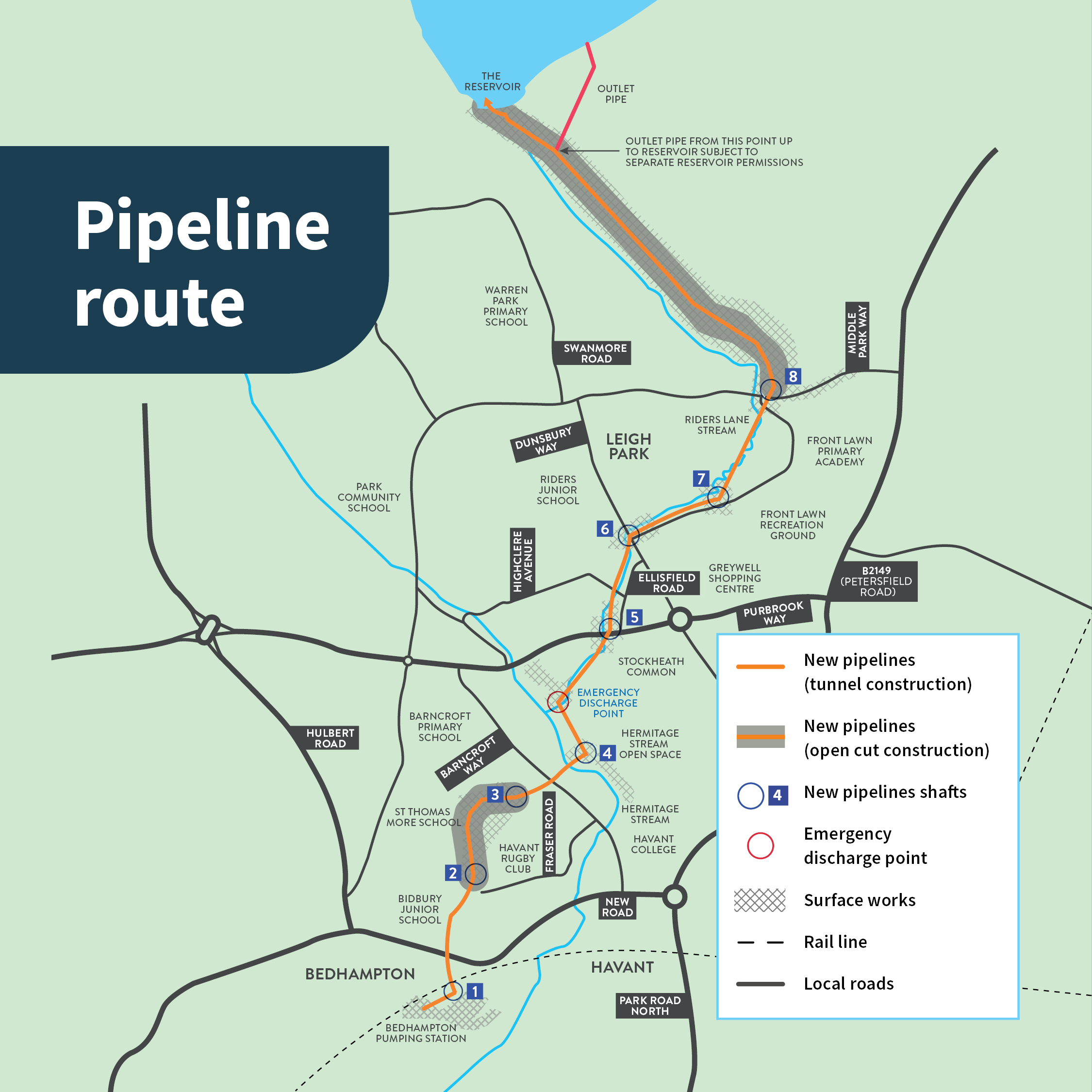
The new pipelines will run side by side underground from Bedhampton Springs to the reservoir site, which is just north of Leigh Park, Havant. One will carry water to the reservoir, and the other pipeline will help supply water during a drought or emergency situation.
You can view a map of the overall pipelines route below and we have also produced a Google Earth-style map, where you can focus in on the pipelines sections you're most interested in to see things in greater detail.
Building the pipelines
We have worked closely with local councils to develop an approach that helps keep disruption as low as possible. Much of the route will be built using micro-tunnelling, which means we can avoid digging up roads and public spaces wherever we can. Two shorter sections will be built by digging trenches for the pipes to go in, before they are covered up again – a technique known as ‘open cut’.
What is micro-tunnelling?
Micro-tunnelling is a way of installing pipelines underground with much less disruption at the surface. A small tunnel boring machine creates the route below ground, while concrete pipe sections are pushed into place behind it using hydraulic jacks. The pipes will each be 1.7 metres wide and from 3 to 10 metres below ground. This allows the pipelines to pass beneath roads, footpaths, public spaces, utilities and tree roots, while avoiding passing directly below homes and other properties.
We will be installing access shafts for the micro-tunnelling in stages to ensure any impact from our work is localised as much as possible.
What is open cut?
Two shorter sections of the pipelines will be installed using an open-cut approach: through Hooks Lane playing fields in Bedhampton and through open space at Staunton Country Park up to the reservoir site.
Open-cut construction is the traditional method of digging a trench, laying the pipe at the right depth, and then restoring the ground once the work is complete.
How the construction work will impact you
To keep disruption to a minimum, we will use micro-tunnelling to install the majority of the reservoir pipelines, as it will be less disruptive. This is because it avoids the need to use an ‘open cut’ method, where trenches would need to be dug in roads and public open spaces for the pipes to go in.
Micro-tunnelling is a technique in which a series of concrete tunnel sections are pushed, using hydraulic jacks, through the ground behind a Micro-Tunnel Boring Machine – a smaller type of tunnelling machine.
We will also be installing the pipeline access shafts in stages to ensure any impact from our work is localised as much as possible. Although ever effort is made to reduce disruption to you, as the pipelines are laid you may experience:
- Parking restrictions around construction sites
- Temporary traffic arrangements
- Noise from construction sites involved in micro-tunnelling, although we will need to keep within limits agreed with Havant Borough Council
More detail on what micro-tunnelling involves, as well as overall our construction plan, can be found in our information leaflet. We are building the pipelines section by section, with initial work having started in Spring 2026, and the main construction phase beginning later in the year.
What we will be doing and when
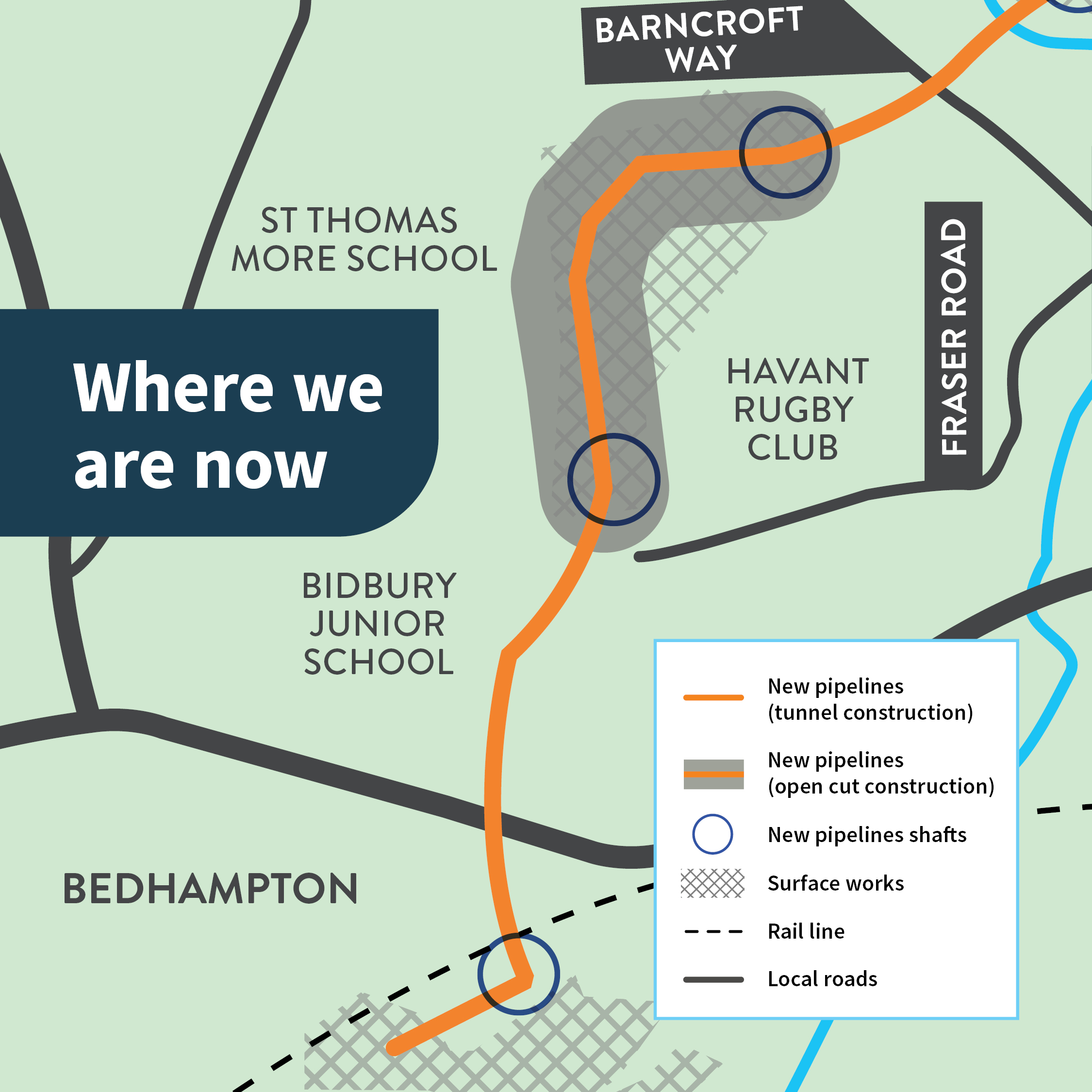
Our aim is to keep any impact on local communities to a minimum while building the pipelines safely and efficiently.
You can find out when we will be working in your area, and what we will be doing, using the links below. The list will be updated as the pipelines installation progresses.
- Meyrick Road / West Street (Shaft W1) - from mid-April 2026
- Fraser Road / Hooks Farm Way / Hooks Lane (Shafts W2 & W3) - from Summer 2026
- Barncroft Way / Stockheath Lane (Shaft W4) - from August 2026
Construction traffic
All construction vehicles will use designated routes to reach the pipelines work areas. Vehicle movements will take place outside of local peak traffic periods as far as possible. We will also limit journeys by Heavy Goods Vehicles (HGVs), such as tipper lorries and articulated lorries, as much as we can.
You can view a map of the main construction routes, and a map of the additional designated route for a tractor & trailer unit to use here.
The routes will be used to transport supplies and equipment from a storage compound at the main reservoir site.
How to get in touch
If you have a question or comment, you can send it to us using the ‘Ask us a question’ tool on this page. You can also leave a virtual pin including feedback on our reservoir pipelines online map.
We will holding a series of public drop-in sessions, when you can meet our team face to face and raise questions or concerns you may have. Details will be listed below once arrangements are confirmed.
Of course, you can contact us by sending an email to havantthicket@portsmouthwater.co.uk, or by calling 023 9249 9888.
And you can write to us at: Havant Thicket Reservoir project, Portsmouth Water, PO Box 99, West Street, Havant, PO9 1LG.
Ask us a question
Please type in your question or comment, and we'll get back to you with an answer as soon as we can.
If you have an urgent issue related to pipelines construction work, please call us on 02392 499888 (lines open 24/7).
-
 HTR MAP_v3.pdf (218 KB) (pdf)
-
Overall c traffic routes map (233 KB) (PDF)
-
Overview plan of pipelines within HTR site (185 KB) (PDF)
-
Detailed plan of pipelines within HTR site (1.48 MB) (PDF)
-
Tractor trailer traffic route map (393 KB) (PDF)
-
HTR Leaflet_v6.pdf (2.18 MB) (pdf)
-
HTR-POR-XX-XX-PL-K-0001 HTR pipelines CLP PO1.pdf (1.13 MB) (pdf)
-
Hooks Lane p fields map.pdf (2.02 MB) (pdf)
-
Pipelines SH briefing PP V02.pdf (14.3 MB) (pdf)
